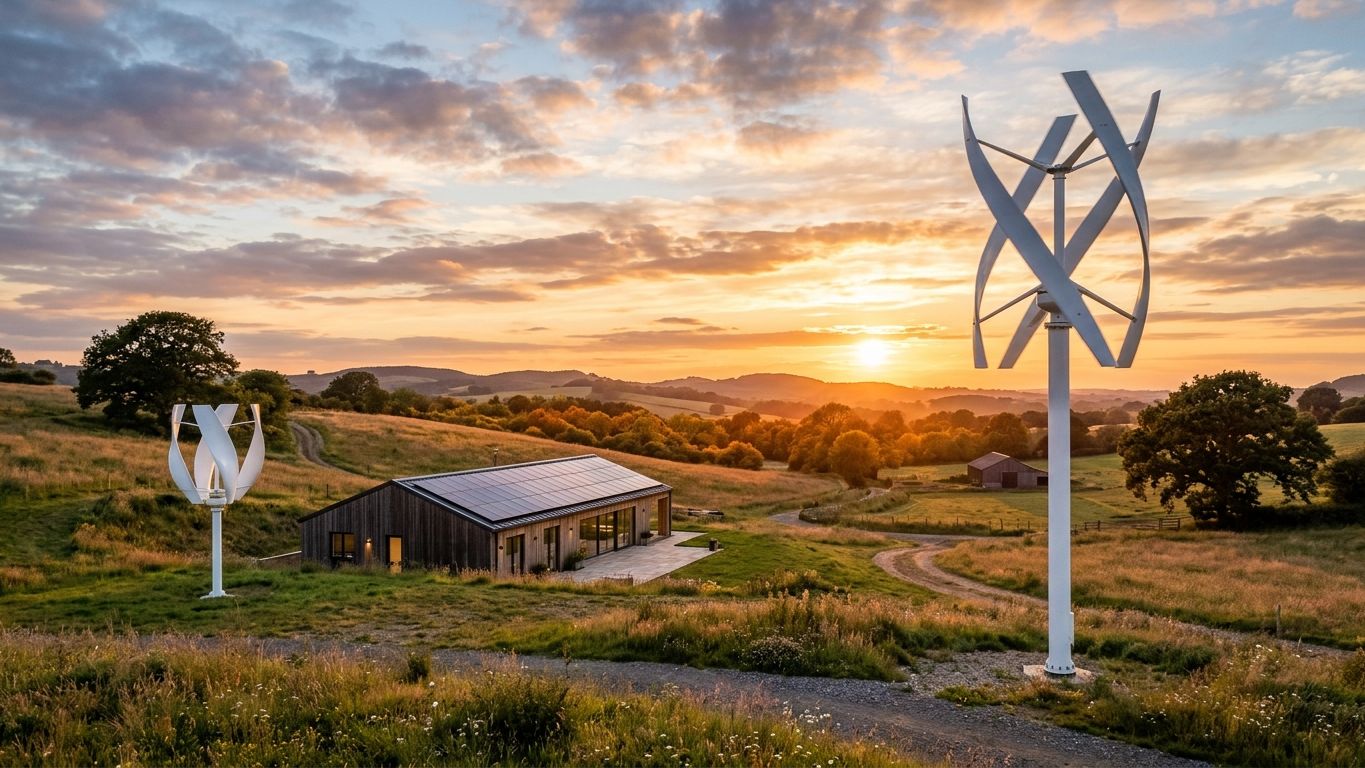
Hybrid power from sun and wind
Vertical-axis turbines, hybrid systems and off-grid power for rooftops, farms, businesses and remote sites, designed around real wind and solar resource assessments.
100% Buyback Guarantee
Not satisfied after 12 months? We buy back your complete hybrid energy system and return every rupee you paid, with no deduction for tax or installation charges. All equipment is taken back.
100% of your money back
Get back the total cost of the project installed at your site.
Zero deductions
No cuts for tax, installation charges or anything else. Whatever you paid, you get back.
We take everything back
All equipment is removed from your site by our team.
Decide after 12 months
Use the system for a full year. Not satisfied? Ask for the buyback.
Offer applies to bookings made on or before 31st December 2026. Ask our team for full offer details.
A practical mix of renewable power technologies
Four complementary product categories for small buildings, commercial loads and remote infrastructure.
Helical VAWT
Smooth rotating blades for compact, multidirectional wind sites.
1.5–10 kWTulip VAWT
Curved petal blades oriented toward high starting torque and visual appeal.
2–15 kWHybrid Solar + Wind
Two sources of generation, with optional battery and grid integration.
3–25 kWOff-grid Solar + Wind
Stand-alone electricity systems supported by planned battery autonomy.
2–50 kWWhere each solution fits
Swipe the table to see more
| Application | Recommended route | First feasibility check |
|---|---|---|
| Homes / rooftops | Helical or small hybrid | Roof strength, turbulence, approvals |
| Farms / villas | Tulip or hybrid | Open wind exposure and daytime demand |
| Shops / institutions | Hybrid solar + wind | Load timing and applicable grid rules |
| Telecom / remote sites | Off-grid solar + wind | Autonomy, peak loads, backup strategy |
Model figures, output forecasts, costs and warranties shown on this page are indicative and require OEM confirmation, a site study and written commercial terms.
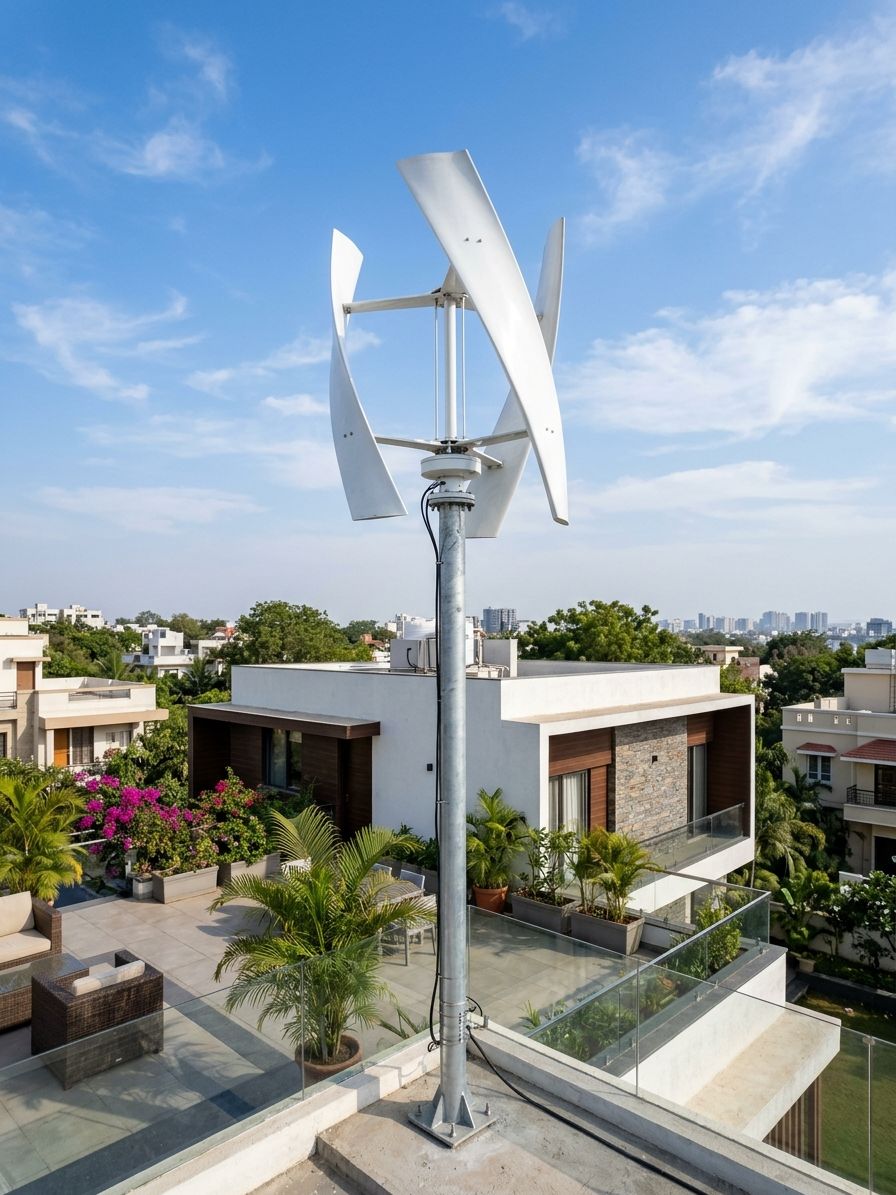
Helical Wind Turbines
A twisted-blade rotor that turns around a vertical shaft and accepts wind from different directions.
1.5–10
kW models
360°
Wind intake
<35 dB
At 5 m (stated)
The idea
A compact rotor for changing wind directions
Three helical aerofoil blades gradually twist around a vertical axis, smoothing the turning force and removing the need for a wind-direction yaw mechanism. Suited to independent homes, terrace-approved apartments, clinics, schools, small shops and bungalows.
Omnidirectional
Responds to shifts in wind direction without yaw control.
Low-noise ambition
Helical geometry moderates torque pulses; acoustics depend on the model.
Rooftop adaptability
Compact format may suit constrained spaces after structural and wind studies.
Rotor blades
Three helical fibreglass-reinforced aerofoil blades
Generator
Three-phase permanent magnet synchronous generator (PMSG)
Design service life
25 years stated in reference material
Warranty
15 years extendable (subject to written OEM warranty)
Indicative technical specifications
Swipe the table to see more
| Parameter | 1.5 kW | 3 kW | 5 kW | 10 kW |
|---|---|---|---|---|
| Rated output | 1.5 kW | 3 kW | 5 kW | 10 kW |
| Start-up wind | 3.5 m/s | 3.5 m/s | 1.8 m/s | 2.0 m/s |
| Rated wind | 10 m/s | 11 m/s | 11 m/s | 12 m/s |
| Survival wind | 50 m/s | 50 m/s | 52 m/s | 55 m/s |
| Suggested tower | 3 m | 5 m | 6 m | 9 m |
Illustrative annual output
kWh per year by average site wind speed
Start-up speed is not rated-power speed. Energy output, noise, tower design and warranty must be confirmed by the OEM and a site study.
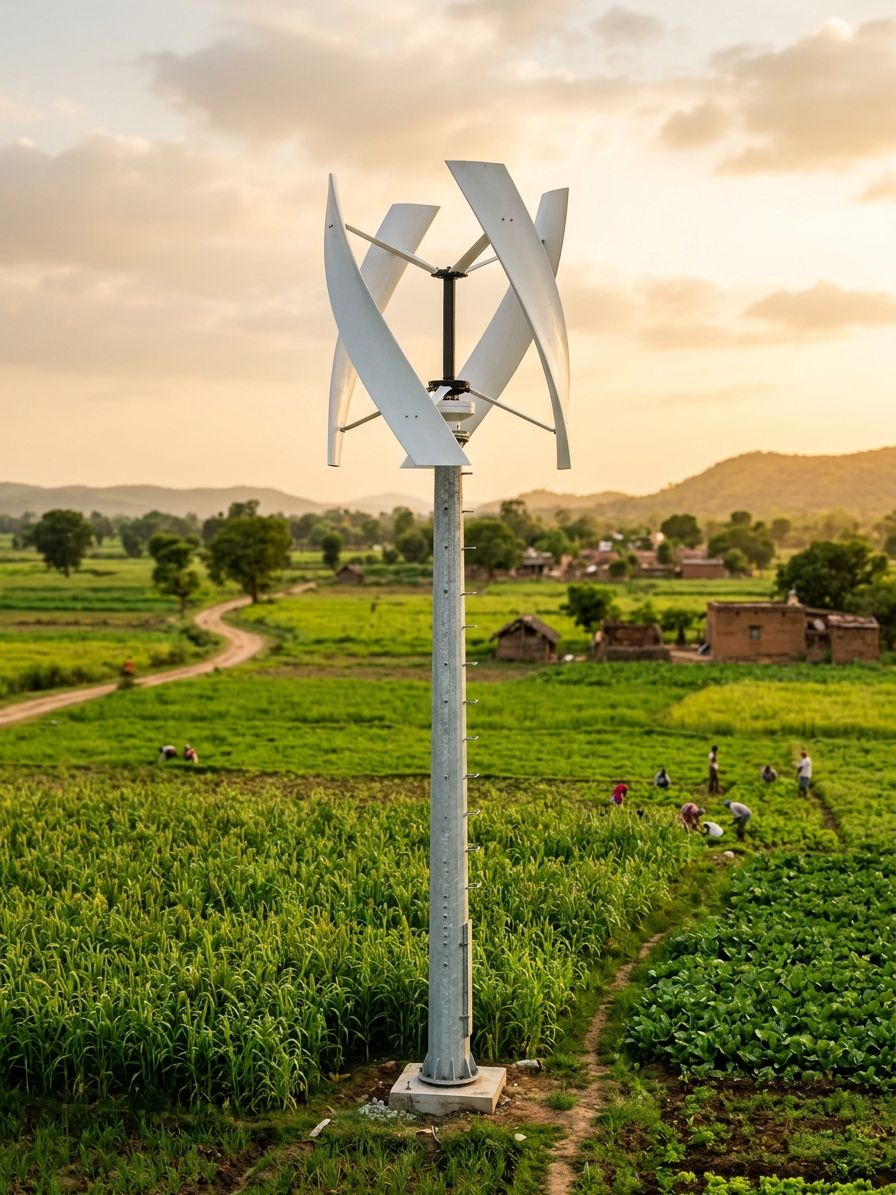
Tulip Vertical Wind Turbines
Four curved, petal-like blades form a distinctive vertical rotor that can generate useful starting torque in variable winds.
2–15
kW range
4
Curved petals
1.8 m/s
Start-up wind
The idea
Petal-profile design for open sites and farms
The rotor combines drag and lift effects. Larger models suit farmhouses, small factories, institutions, resorts and agricultural operations where wind and structure permit.
High starting torque
Petal geometry is designed to start turning in light winds.
Striking presence
A sculptural rotor that works as a visible renewable landmark.
Larger capacities
Up to 15 kW classes for farms, resorts and small industry.
Blades
Composite curved petal blades
Survival wind
55 m/s stated in reference material
Operating sound
Under 38 dB at 5 m (stated)
Warranty
20 years (subject to written OEM warranty)
Indicative technical specifications
Swipe the table to see more
| Parameter | 2 kW | 5 kW | 10 kW | 15 kW |
|---|---|---|---|---|
| Rated output | 2 kW | 5 kW | 10 kW | 15 kW |
| Start-up wind | 1.8 m/s | 1.8 m/s | 2.0 m/s | 2.2 m/s |
| Rated wind | 10 m/s | 11 m/s | 12 m/s | 12 m/s |
| Stated peak efficiency | 42% | 44% | 45% | 45% |
Illustrative annual output
kWh per year by average site wind speed
Output estimates are indicative. Efficiency, cyclone suitability and warranty claims require independent test reports and written product terms.
Helical vs Tulip at a glance
The most useful comparison is based on wind resource and validated power curves, not appearance alone.
Swipe the table to see more
| Decision factor | Helical | Tulip |
|---|---|---|
| Rotor profile | Twisted helix | Curved petals |
| Potential focus | Rooftop, compact urban sites | Open sites, farms, larger units |
| Reference sizes | 1.5 / 3 / 5 / 10 kW | 2 / 5 / 10 / 15 kW |
| Reference noise | Under 35 dB at 5 m | Under 38 dB at 5 m |
| Selection priority | Acoustic + structure assessment | Torque + site-resource assessment |
One system. Complementary resources.
Hybrid systems combine solar panels with a wind generator, power electronics and optional storage to widen the hours you generate power.
3–25
kW concept classes
2
Energy sources
Opt.
Battery storage
How the two sources complement each other
Conceptual daily resource profile, not measured data
Broader production hours
Wind can contribute outside solar daylight hours when conditions allow.
Monsoon complement
Wind may offset reduced solar irradiation at suitable sites.
Backup capability
Storage and correctly configured inverters can support essential loads during outages.
Site economics
Self-consumption, export rules, equipment cost and maintenance determine economics.
Energy path
Example hybrid configurations
2–3 BHK home
Home 3 kW
- Solar
- 2 kW
- Wind
- 1.5 kW helical
- Storage
- 5 kWh optional
Yield ~5,500 kWh/yr
Saving ₹3,500–5,500/mo
Payback 4–6 yrs
Villa / larger home
Home 5 kW
- Solar
- 3 kW
- Wind
- 2 kW tulip
- Storage
- 10 kWh optional
Yield ~9,000 kWh/yr
Saving ₹6,000–9,000/mo
Payback 4–6 yrs
Pump / dairy / farm
Farm 10 kW
- Solar
- 5 kW
- Wind
- 5 kW tulip
- Storage
- 20 kWh
Yield ~18,000 kWh/yr
Saving ₹12,000–18,000/mo
Payback 3–5 yrs
Office / shop / clinic
Commercial 15 kW
- Solar
- 10 kW
- Wind
- 5 kW tulip
- Storage
- 30 kWh optional
Yield ~28,000 kWh/yr
Saving ₹22,000–35,000/mo
Payback 4–6 yrs
School / factory / hotel
Commercial 25 kW
- Solar
- 15 kW
- Wind
- 10 kW tulip
- Storage
- 50 kWh optional
Yield ~48,000 kWh/yr
Saving ₹40,000–65,000/mo
Payback 3–5 yrs
Configuration names are concept classes, not the arithmetic sum of components. Yield, saving and payback figures are indicative scenarios (based on a retail tariff of roughly ₹7–12/kWh), not quotations or promised returns.
Off-grid wind + solar power
An independent energy system for sites without dependable grid access, combining renewable generation with a correctly sized battery bank.
2–50
kW classes
2–4
Days autonomy*
LFP
Battery option
Telecom & monitoring
Sites with always-on electronics and difficult fuel logistics.
Farms & pumping
Irrigation, cold storage and dairy loads with suitable controls.
Remote hospitality
Lodges and research camps outside stable grid networks.
System components
Wind rotor
Helical or tulip machine sized to measured wind.
PV array
Solar modules oriented for site irradiance and shadow limits.
Controller
Multi-source charging and protection coordination.
LiFePO4 bank
Usable energy capacity, BMS and thermal protections.
Inverter
AC sine-wave output with surge and safety ratings.
Monitoring
Optional GSM/4G telemetry, alerts and diagnostics.
For mission-critical facilities, an optional standby generator can be specified for extended low-resource periods.
Examples by application
Swipe the table to see more
| Application | Wind | Solar | Battery | Daily output* |
|---|---|---|---|---|
| Telecom: small | 2 kW | 3 kW | 10 kWh | ~15 kWh |
| Telecom: large | 5 kW | 10 kW | 30 kWh | ~45 kWh |
| Remote farm pump | 3 kW | 5 kW | 15 kWh | ~25 kWh |
| Mountain lodge | 5 kW | 8 kW | 40 kWh | ~38 kWh |
| Village micro-grid | 10 kW | 15 kW | 80 kWh | ~75 kWh |
| Research station | 5 kW | 8 kW | 30 kWh | ~38 kWh |
Illustrative daily energy
kWh per day
How it compares with diesel backup
Swipe the table to see more
| Factor | Diesel generator | Renewable off-grid |
|---|---|---|
| Energy source | Purchased fuel | Wind + sunlight with storage |
| Running costs | Fuel, periodic service | O&M, battery and component replacement |
| Emissions at site | Combustion exhaust | No exhaust during renewable operation |
| Sound | Combustion and mechanical noise | Turbine and electrical equipment noise |
| Reliability risks | Fuel shortage, engine failure | Low resource, inverter or battery failure |
*Battery autonomy and daily output are engineering targets that depend on daily demand, usable battery capacity and site resources. "Zero fuel cost" does not mean zero cost per kWh: compare full lifecycle costs.
From assessment to handover
A disciplined engineering workflow turns a concept into a site-specific power system.
Survey
Resource, load and access conditions.
Design
Turbine / PV / storage sizing and single-line diagram.
Commercial
Verified bill of materials, exclusions and quotation.
Procure
OEM evidence, delivery and logistics.
Install
Civil works, electrical protections and testing.
Commission
Performance checks and operator briefing.
Monitor
Alarms, maintenance and data review.
What we need to size your system
Site evidence prevents misleading power projections.
Location & surroundings
Wind obstacles, elevation and layout
Load profile
Monthly kWh, peak kW and critical loads
Wind resource
Measured distribution at planned hub height
Solar resource
Shading, tilt, orientation and module area
Grid conditions
Tariff, outages, export and connection rules
Structures & safety
Loads, anchors, setbacks and lightning
Power requirements
Battery autonomy, surge, phase and voltage
Commercial scope
OEM model, warranty, taxes, service, lead time
Indicative market budgets
Reference bands to help you plan, not Dewberry Enterprise offers.
Transport, taxes, structures, warranty, approvals and supplier-specific equipment may change pricing materially. Final pricing is confirmed only in a written quotation.
Common questions
Turn a renewable energy idea into a site-ready plan.
Share your location, recent electricity bills, available roof or ground area and critical loads to start a technical discussion with our team.
Office 606, 6th Floor, The Citadel, Opp. Star Bazaar, Adajan, Surat, Gujarat 395009, India